
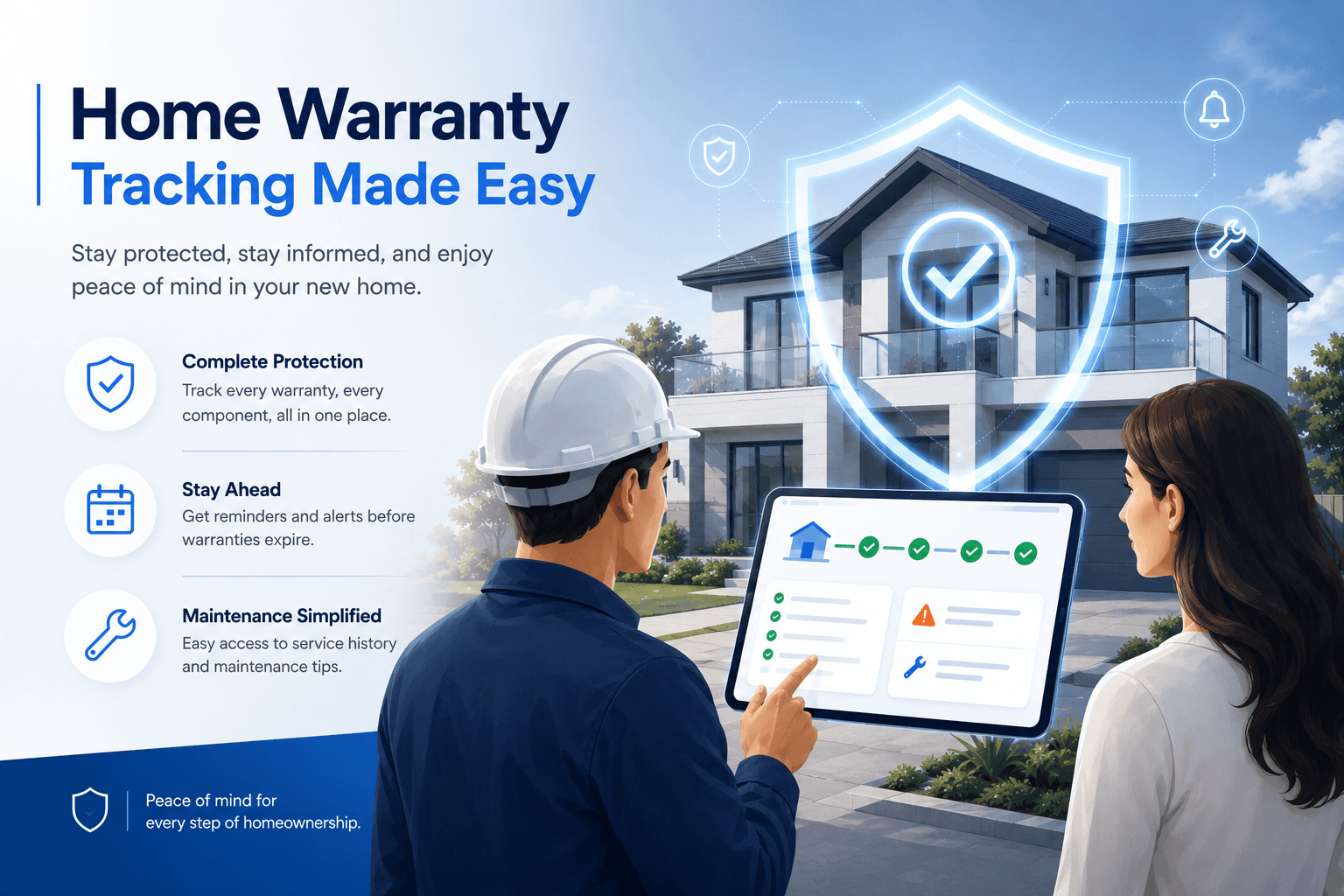
What Is Home Warranty Tracking and Why Does It Matter in 2026?
Home warranty tracking means keeping tabs on every warranty that comes with a newly built home. That includes the one-year workmanship coverage, the two-year systems coverage for things like HVAC and plumbing, and the ten-year structural warranty. For builders, having a clear system for all of this means fewer unexpected service calls and less legal risk. For buyers, it means knowing exactly what is covered, when it runs out, and who to call if something breaks.
Right now, most builders are still managing this with spreadsheets, paper folders, or a mix of both. The National Association of Home Builders (NAHB) has found that builders who switch to digital homeowner tools see higher satisfaction scores and spend noticeably less on post-close support. Tools like Flannel.ai are making that switch straightforward, turning what used to be a headache for both sides into something that just works.
The Builder’s Problem: Chasing Down Paperwork After Every Complaint
Picture the typical warranty call. A homeowner rings in with a complaint. Someone on the builder’s team has to dig through old files to find the install date, figure out which subcontractor did the work, and then check whether the problem falls under the one-year, two-year, or ten-year window. That takes time. And it costs money in ways that are easy to overlook.
Here is where the real damage shows up:
- Wasted staff hours: Sales counselors and project managers spend chunks of every week answering warranty questions instead of moving active builds forward.
- Paying for repairs that should not be yours: Without everything in one organized place, builders frequently cover costs that a manufacturer or subcontractor should have handled. This is sometimes called warranty leakage, and it adds up fast.
- Reputation hits: Homeowners who feel ignored or confused during the warranty process leave bad reviews. On platforms like Houzz and Google, those reviews stick around.
A proper builder warranty tracker fixes all three of these by putting everything in one place, handling the routine sorting automatically, and keeping a clear record of every interaction.
The Buyer’s Problem: Nobody Explains the Fine Print After Move-In
The first year in a new home is a lot to navigate. Most buyers do not fully understand what their warranty actually covers until something goes wrong. And when it does, they want an answer fast, not a stack of documents to dig through.
Without a good warranty tracking app, homeowners keep running into the same problems:
- They forget about maintenance deadlines. Flushing the water heater once a year sounds simple, but most people never do it. Miss enough of those tasks and the warranty on that system can be voided.
- They call the builder for things that are not covered. A door that squeaks or a tile that feels slightly uneven often falls under normal wear, not a builder’s defect. When the builder says no, both sides end up frustrated.
- They lose track of which warranty covers what. One year, two years, ten years. Most buyers cannot remember which window applies to which part of the house, and nobody walks them through it after closing day.
When all of this piles up, the post-close relationship starts to feel like a fight, even when everyone went into it with good intentions.
Did you know?
30% fewer service calls
Builders using AI-driven warranty tracking report a 30% drop in service call volume within the first six months of a homeowner moving in.
How Flannel.ai Takes Care of Home Warranty Tracking End to End
Flannel.ai is a digital home binder built for residential builders. It is not a filing cabinet. It actively manages everything that touches the health of a home, starting from the day of closing and running all the way through the end of the structural warranty.
Here is what that actually looks like day to day.
1. One Smart Home Profile for Every Property
When a builder adds a home to Flannel.ai, the platform builds a complete profile for that specific property. Every piece of documentation lives there: appliance manuals, subcontractor contact info, inspection reports, paint colors, filter sizes, and all the warranty paperwork. Everything is searchable.
A homeowner can type a plain question like: “Is my dishwasher still under warranty?”
Flannel.ai looks up the install date, checks it against the manufacturer’s policy, and answers straight away: “Yes. Your Bosch dishwasher is covered under a 2-year parts-and-labor warranty. That coverage runs until March 2027.”
That one feature handles the most common type of call builders get every single week.
2. Reminders That Go Out Before Problems Start
The cheapest warranty repair is the one that never happens. Flannel.ai sends maintenance reminders based on the actual equipment in each home, not a one-size-fits-all schedule.
A homeowner might receive a message like:
- “Time for your quarterly HVAC filter swap. Your system takes a 16x25x1. Order here.”
- “Freeze warning in your area tonight. Disconnect your exterior hose bibs to keep your plumbing warranty valid.”
- “Your 11-month walkthrough window closes in 30 days. Any items to submit? Do it here.”
These reminders do two things at once. They keep homeowners on track, and they give the builder solid documentation that proper guidance was provided if a dispute ever comes up later.
3. Service Requests That Come In Organized and Pre-Sorted
When something genuinely needs to be fixed, homeowners submit requests through Flannel.ai with photos and all the relevant home information already attached. Before that request ever reaches the builder’s team, the AI reviews it.
If it is a hairline crack in drywall from normal settling, the AI explains that clearly and sets the right expectation before anyone on the builder’s team has to get involved. If it is an HVAC failure that falls squarely within the two-year systems coverage, the AI confirms it, collects the paperwork, and sends it to the right person.
This sorting step alone removes a significant chunk of unnecessary back-and-forth from the builder’s day.
Want to see this working on a real home?
We will walk you through exactly how Flannel.ai handles warranty tracking for your specific setup.
The Old Way vs. the Flannel.ai Way
| What Gets Managed | Traditional Approach | With Flannel.ai |
|---|---|---|
| Document Storage | Paper binders or static PDFs | Searchable digital profile for every home |
| Answering Questions | Email chains, sometimes days | AI answers instantly, any time |
| Maintenance Reminders | Homeowner has to remember | Automatic alerts tied to that home’s equipment |
| Accuracy of Records | Prone to human error | Synced directly to the home’s actual specs |
| Sorting Service Requests | Manual, slow, easy to miss | AI reviews and sorts before staff gets involved |
| How the Brand Comes Across | Disconnected and frustrating | Supportive, modern, and professional |
What builders are saying:
“We used to have one team member spending almost two full days a week on warranty calls. That number dropped significantly within the first few months of using Flannel.ai.”
Early Adopter, Flannel.ai Builder Program
Why the Builders Who Act Now Will Be Hard to Compete With Later
Builders in 2026 are not just competing on square footage or countertop finishes. They are competing on what it feels like to own one of their homes, and the post-close period is where that reputation gets built or lost.
A few things happening in the industry right now make this very clear:
- Builders using AI-powered warranty tools are reporting a 30% drop in service call volume within the first six months after a homeowner moves in.
- According to the National Association of Realtors (NAR), roughly 9 out of 10 buyers say they would work with their builder again, but most never actually refer anyone. Giving homeowners a genuinely helpful post-close experience is one of the most reliable ways to turn that intention into action.
- The U.S. Department of Energy has identified smart home management tools as one of the key factors in long-term home performance and owner satisfaction.
A year ago, offering a digital warranty platform made a builder stand out. Today it is becoming something buyers expect regardless of price point.
How to Get Flannel.ai Running Before Your Next Closing
Most builders are fully set up and ready to go within a few days. There is no complicated software install or lengthy onboarding process.
- Build the home profile.During the closing process, upload everything related to that home. Warranties, appliance manuals, subcontractor contacts, inspection reports, paint colors, and filter sizes. If a homeowner might ever need to know it, it goes in here.
- Send the homeowner their link.The buyer gets a personal link to their digital home binder. From their first day in the house, they have everything they need in one place on their phone or computer.
- Let the reminders run themselves.Flannel.ai looks at the equipment in the home and sets up a maintenance schedule automatically. No one on the builder’s team has to configure it manually for each property.
- Watch everything from one dashboard.The builder’s team has a single view of all active homes, open service requests, and warranty timelines. If something needs attention, it is easy to spot.
Already building homes?
Join the Flannel.ai Early Adopter Program and help shape how the platform works for builders like you.
Frequently Asked Questions About Home Warranty Tracking
What is a home warranty tracker?
It is a tool that keeps all of a home’s warranty documents organized, tracks when different types of coverage expire, and helps both builders and homeowners handle maintenance and service requests in one place. It can be a simple spreadsheet or a full digital platform like Flannel.ai.
How long does a builder warranty last on a new home?
The standard structure most builders follow is one year for workmanship issues, two years for major systems like HVAC, plumbing, and electrical, and ten years for structural problems. The exact terms depend on the builder and the state the home is in.
Can a homeowner accidentally void their builder warranty?
Yes. Skipping regular maintenance tasks, like changing HVAC filters or having appliances serviced, can void the warranty on those systems if something goes wrong later. A warranty tracking app with automated reminders helps homeowners stay on top of those tasks before they become an issue.
What exactly is a digital home binder?
A digital home binder is a secure, cloud-based platform where all of a home’s important documents live in one place. Warranties, manuals, service records, and maintenance history are all stored there and easy to search. Flannel.ai adds AI-powered chat and automated reminders on top of that.
How does Flannel.ai cut down on builder service calls?
Two ways. First, it sends timely maintenance reminders that prevent a lot of common issues before they happen. Second, its AI reviews incoming service requests and handles the straightforward ones without the builder’s team having to get involved. Builders in the early adopter program have reported a 30% drop in service call volume within the first six months.
Does Flannel.ai work for smaller builders too?
Yes. The platform is built to work at any size, from a custom builder doing five homes a year to a developer doing thousands. Pricing is per home, so it scales with your business rather than asking you to pay for more than you need.
The Builders Who Win Long-Term Are Already Thinking About What Happens After Closing
Home warranty tracking is not a bonus feature for builders who want to stand out. It is the foundation of a post-close experience that protects your margins, keeps your team focused on building instead of fielding calls, and earns the kind of word-of-mouth that actually brings in new buyers.
The relationship with a homeowner does not end on closing day. It starts there. With Flannel.ai, every home you hand over comes with a system that looks out for both the buyer and your business, long after the keys have changed hands.