Here we break down the top mistakes builders make after closing a home sale, and what to do instead before they start costing you reputation and revenue. In the homebuilding industry, closing day is often treated like the finish line. The financing is done, the keys are handed over, and the builder’s team pivots to the next project. For the homeowner, though, closing day is actually the starting gun. It is the moment their real experience with your product truly begins.
When builders go quiet the moment the check clears, they are not just missing a chance to say thank you. They are actively eroding the trust they spent months building. Avoiding common post-closing mistakes is the difference between a one-time transaction and a lifelong brand advocate who sends five referrals over the next decade.
Here are the five mistakes builders are making right now in the after-sales phase, and what to do instead before they start costing you reputation and revenue.
The real cost of getting this wrong
12 months
Your reputation as a builder is largely built or lost in the first year after closing. Most builders never realize it until the reviews start rolling in.
Mistake 1: Going Completely Silent After Move-In
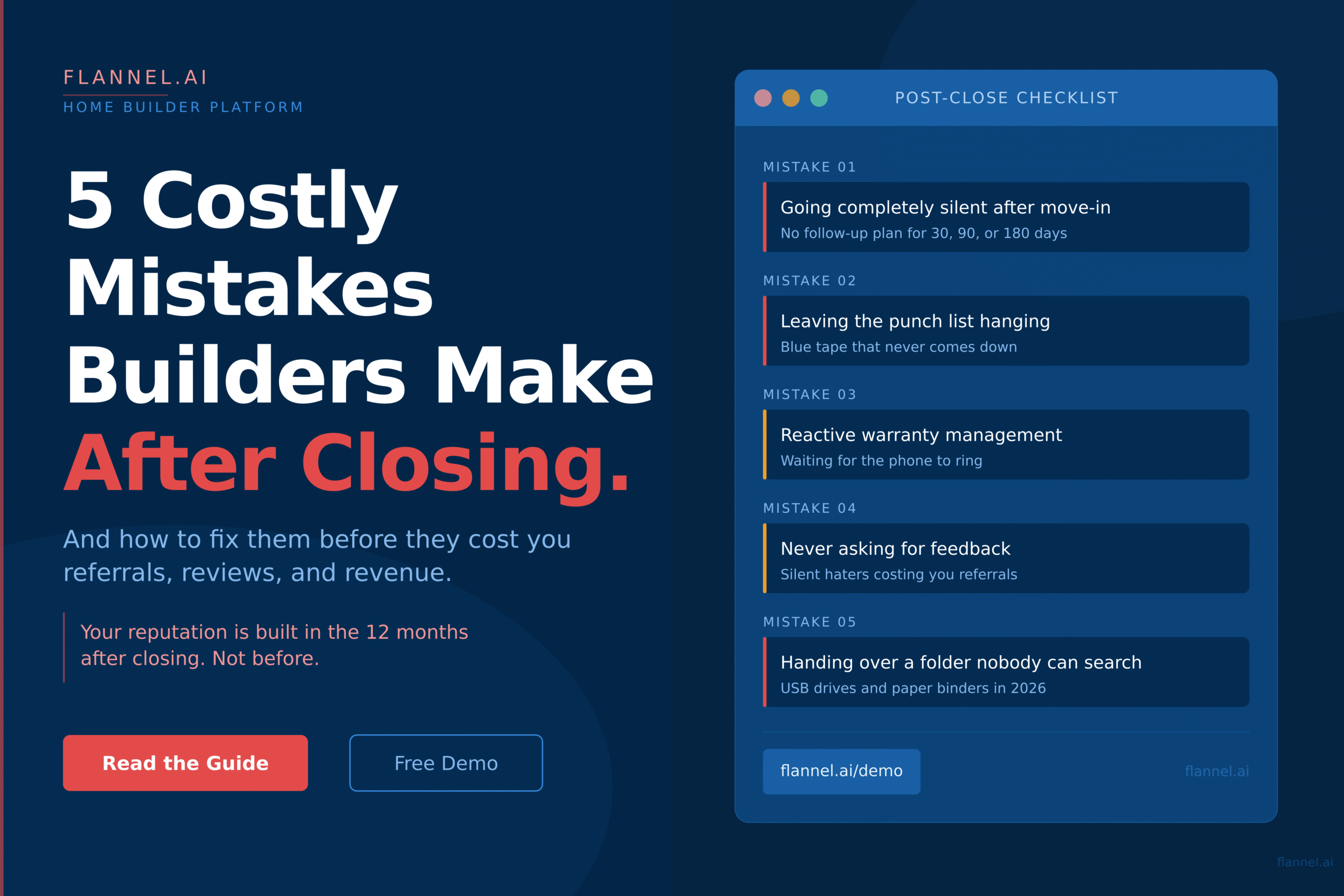
Mistake 01
The radio silence effect
- The mistake: No structured follow-up plan for the first 30, 90, or 180 days after closing. The homeowner goes from weekly contact to nothing overnight.
- The cost: Homeowners feel used for the sale. When minor issues come up, their frustration is bigger than it would otherwise be because they feel they no longer have a direct line to anyone.
- The fix: Automate a “Welcome Home” sequence. A simple text or email at day seven asking how the first week went can defuse tension before it ever starts.
After months of weekly walkthroughs and updates, the silence after move-in can feel like abandonment to a new homeowner. This is not a small thing. According to the National Association of Home Builders (NAHB), post-close communication is one of the top drivers of homeowner satisfaction scores. Builders who maintain contact in the first 90 days consistently outperform those who do not.
The fix does not need to be complicated. A short check-in at day seven, a quick note at the 30-day mark, and a maintenance reminder at 90 days will do more for your referral rate than almost any marketing spend.
Mistake 2: Leaving the Punch List Hanging
Mistake 02
Blue tape that never comes down
- The mistake: Assuming that once the Certificate of Occupancy is issued, minor cosmetic fixes can wait indefinitely.
- The cost: Small items like a scratched cabinet or a missing switch plate become major psychological burdens. Every time the homeowner sees that blue tape, they think of your company’s lack of follow-through.
- The fix: Use a digital punch-list tool that gives the homeowner a clear completion date. Transparency on when it will be fixed is often more important than fixing it instantly.
Nothing kills a new homeowner’s excitement faster than a punch list that drags on for weeks. The item itself almost does not matter. What matters is the feeling that the builder stopped caring the moment the money changed hands. A clear timeline with visible progress updates changes that feeling entirely.
Tired of managing punch lists by phone and email?
Flannel.ai gives builders and homeowners one shared place to track open items, completion dates, and service requests.
Mistake 3: Waiting for the Phone to Ring on Warranty Issues
Mistake 03
Reactive warranty management
- The mistake: Not educating the homeowner on how to maintain their new systems, including HVAC filters, exterior drainage, and sump pumps.
- The cost: Avoidable maintenance issues turn into expensive warranty claims. If a homeowner does not know to change an air filter and the furnace fails, the builder often ends up covering the service call just to keep the peace.
- The fix: Provide a digital maintenance assistant. Tools like Flannel.ai send proactive reminders to the homeowner’s phone, ensuring the home is cared for and reducing warranty liability for the builder.
Most builders wait for the complaint to come in. By that point, the damage is already done, in some cases literally. Proactive maintenance education is one of the simplest and highest-return investments a builder can make in the post-close phase. Builders using AI-driven tools like Flannel.ai report a 30% drop in service call volume within the first six months of occupancy, according to early adopter data.
Mistake 4: Never Asking for Feedback
Mistake 04
Skipping the post-occupancy survey
- The mistake: Avoiding a structured review or survey 60 days after move-in out of fear that it will open up new complaints.
- The cost: You lose the chance to catch a “silent hater” who is complaining about you to neighbors but has not called your office. You also miss the window to earn a five-star Google review while the new home feeling is still fresh.
- The fix: Set a calendar trigger to request a review only after the punch list is 100% complete. That way, the homeowner’s most recent memory of your company is a win.
Builders who are afraid to ask for feedback are usually the ones who need it most. The homeowners who feel strongly enough to leave a negative review online are only a fraction of the people who are quietly telling their friends and neighbors. A structured, well-timed survey gives you a chance to catch problems before they become public, and to turn happy customers into active referral sources.
What the data shows
“Builders who ask for structured feedback within 60 days of closing see significantly higher referral rates than those who do not follow up at all.”
NAHB Customer Satisfaction Research, 2025
Mistake 5: Handing Over a Folder Nobody Can Search
Mistake 05
The unsearchable home handoff
- The mistake: Handing over a USB drive or a physical binder and assuming the homeowner will find what they need when they need it.
- The cost: Every time a homeowner cannot find a paint code or the location of a shut-off valve, they call you. This creates a constant stream of low-value support calls that eat up staff time.
- The fix: Give your clients a searchable Smart Home Brain. When a homeowner can type “What color is the trim in the nursery?” and get an instant answer, those support calls stop coming.
In 2026, homeowners expect to find answers as fast as they can search for them online. Handing someone a folder of PDFs and hoping for the best is the equivalent of telling them to go to the library. A searchable digital home binder removes the friction entirely and eliminates the majority of inbound “where is this?” calls your team receives every week.
The Amateur Approach vs. the Professional Approach
| Area | The Amateur Approach | The Professional (Flannel.ai) Way |
|---|---|---|
| Home Handoff | A physical binder of paper manuals | A searchable, AI-driven Digital Home Binder |
| Communication | Reactive, responding to complaints | Proactive, scheduled check-ins |
| Maintenance | “Good luck, read the manual” | Automated, home-specific alerts |
| Warranty | Confusing legal language homeowners ignore | Instant AI answers on what is covered |
| Referrals | Hoping for the best | A systematized brand presence that stays active |
Ready to make the switch?
Join builders already using Flannel.ai to turn the post-close period into their strongest referral engine.
Frequently Asked Questions About Post-Closing Builder Mistakes
What is the most common mistake builders make after closing?
The most common mistake is going silent. After months of active communication during the build, many builders stop reaching out the moment the keys are handed over. This sudden drop in contact makes homeowners feel like the relationship was purely transactional, which directly hurts referral rates and online reviews.
How does reactive warranty management cost builders money?
When builders wait for homeowners to call with complaints, many of those complaints could have been prevented with basic maintenance reminders. A homeowner who does not know to change an HVAC filter may end up with a furnace failure. Even if the builder is not technically responsible, they often absorb the cost of the service call to protect the relationship and their reputation.
When is the best time to ask a homeowner for a review?
The best time to ask for a review is right after the punch list is 100% complete. That way, the homeowner’s most recent experience with your company is a positive one. Asking too early, while open items are still pending, can backfire and result in a negative review about unfinished work.
What is a digital home binder and how does it help builders?
A digital home binder is a cloud-based platform that stores everything about a specific home in one searchable place: warranties, manuals, paint colors, subcontractor contacts, and maintenance schedules. For builders, it eliminates the constant stream of “where is this?” support calls and creates a professional, modern handoff experience that homeowners actually remember positively.
How does Flannel.ai help builders avoid post-closing mistakes?
Flannel.ai addresses all five of these mistakes in one platform. It automates post-close communication, tracks punch list items, sends proactive maintenance reminders, prompts homeowners to leave reviews at the right time, and gives every homeowner a searchable digital binder for their specific home.
Does a better post-close experience actually increase referrals?
Yes, significantly. Research from the National Association of Realtors (NAR) consistently shows that buyers who have a positive post-close experience are far more likely to refer friends and family. The referral gap, where buyers say they would recommend a builder but never actually do, closes when the post-close experience gives them something worth talking about.
Why Mistakes Builders Make After Closing Cost You the Most
Every mistake on this list comes from the same root assumption: that the customer service phase ends when construction does. In reality, your reputation as a builder is shaped almost entirely by what happens in the 12 months after the keys change hands.
Builders who move from a reactive, paper-based handoff to a proactive, AI-supported experience with Flannel.ai do not just avoid these errors. They build a referral machine that compounds over time.