Why Revenue-First Builders Win in 2026
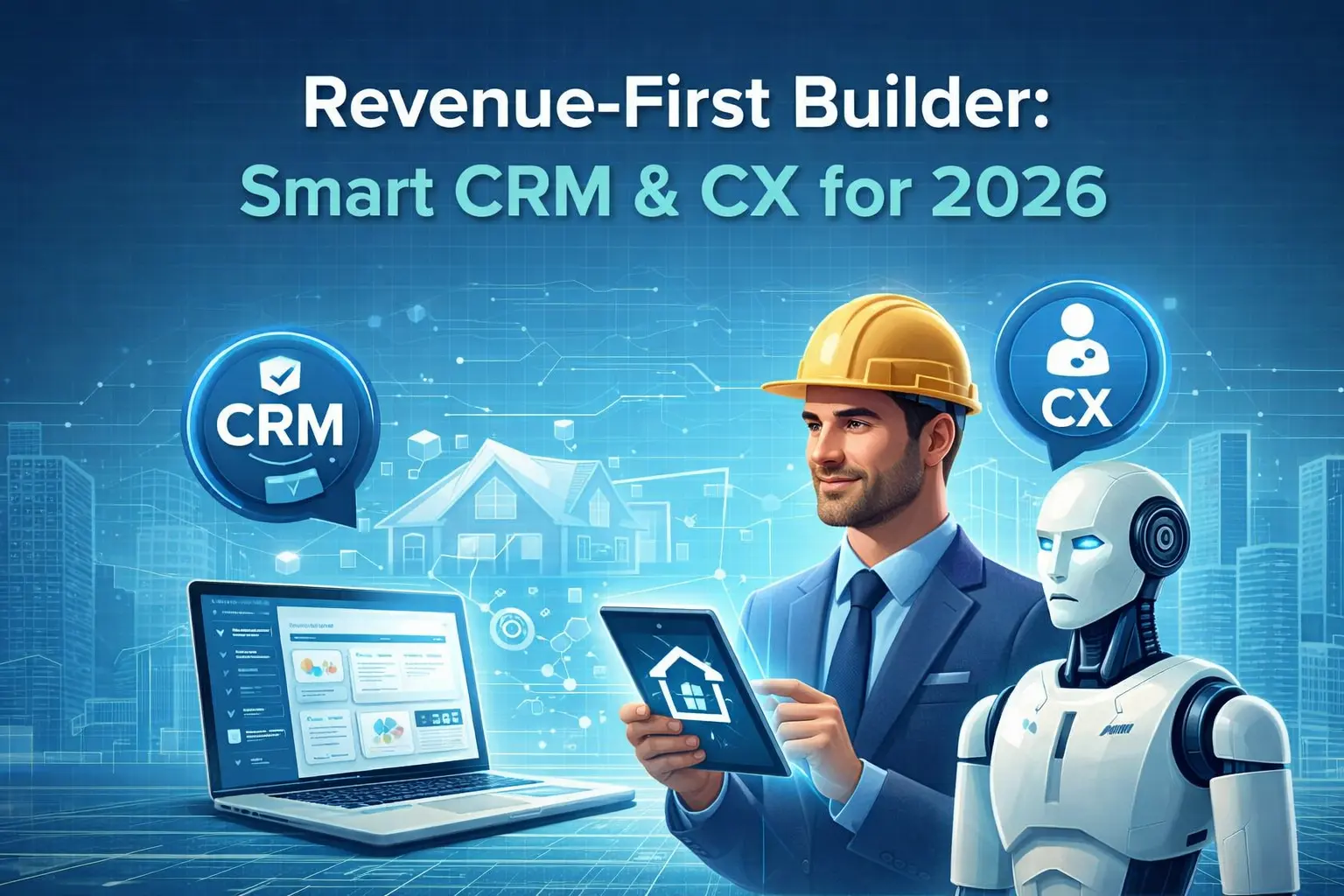
In 2026, the homebuilding market looks very different. The Revenue-First Builder model shifts marketing from volume-based tactics to revenue-driven strategy. The easy wins, the so-called “low-hanging fruit” are gone. Today’s buyers are cautious, research-driven, and digitally empowered. The modern builder must go beyond lead generation and prioritize maximizing the value of every customer interaction through CRM and CX optimization.
Revenue growth no longer depends on billboards or mass email campaigns. Instead, it depends on building an intelligent, AI-powered Customer Experience (CX) supported by a specialized CRM for builders that tracks intent, attribution, and revenue impact from the very first interaction.
1. The Intelligent Front-End: Finding Customers Before the Form
Identifying High-Intent Buyers in the Anonymous Research Phase
In 2026, nearly 80% of the buyer’s journey happens before a prospect speaks to an Online Sales Counselor (OSC).A strong Revenue-First Builder strategy also integrates modern smart home marketing automation tools. The most advanced revenue-first builders use intent data and AI-driven analytics to identify prospects long before they submit a form.
Intent-Based Marketing Platforms
Modern home builders use tools like:
- G2 Intent Data
- NoviHome
- Behavioral tracking systems integrated into CRM platforms
These tools identify households repeatedly viewing:
- Specific floor plans
- Community maps
- Pricing pages
- Incentive offers
By capturing this behavioral data inside a CRM for builders, marketing teams can prioritize high-intent prospects instead of treating every visitor equally.
Hyper-Personalization with Progressive Profiling
Platforms like HubSpot CRM for builders and Lasso CRM now offer progressive profiling.
Instead of overwhelming a visitor with a 10-field form, the website asks one micro-question per visit, such as:
- Preferred move-in date
- Budget range
- Desired school district
Over time, the CRM builds a detailed buyer profile without friction, boosting conversion rates significantly.
2. The Core Engine: Specialized CRM for Builders in 2026
A generic CRM is no longer enough. Every Revenue-First Builder relies on a specialized CRM for builders to track buyer intent. The revenue-first builder relies on a specialized CRM system that connects marketing spend directly to closed revenue.
Best CRM Platforms for Home Builders (2026)
| CRM Platform | Best For | Standout 2026 Feature |
|---|---|---|
| Lasso CRM | New Home Sales & Marketing | Builder-specific workflows and OSC automation |
| HubSpot for Builders | Inbound & Lead Generation | Advanced automation + AI email assistants |
| Salesforce (Custom) | Enterprise Builders | Enterprise scalability and advanced reporting |
| Buildertrend CRM | SMB Builders & Remodelers | Sales-to-project budget integration |
| Nutshell CRM | Growing Teams | Visual pipeline with minimal complexity |
These platforms enable:
- Closed-loop revenue attribution
- Automated lead nurturing
- Sales team task automation
- Real-time reporting dashboards
3. CX as the Ultimate Lead Generation Tool
In residential construction, Customer Experience (CX) is the new SEO. The digital experience during the discovery phase determines whether a prospect converts or bounces.
The Virtual Showroom Strategy
Model homes are no longer the first touchpoint, they are the final validation stage.
Interactive Site Maps
Tools like LotVue allow prospects to view real-time lot availability. Nothing creates urgency faster than seeing a “Sold” label appear on a previously available lot.
Generative Floor Plan Customization
AI-powered visualization tools allow prospects to:
- Move interior walls
- Expand garages
- Adjust layout configurations
This creates psychological ownership making prospects up to 4x more likely to convert.
Conversational AI and 24/7 Responsiveness
Speed-to-lead is critical in 2026.
If a prospect asks a question Saturday at 9 PM and waits until Monday for a reply, you’ve already lost them.
Agentic AI Chatbots
Modern AI chat tools (like Drift or Jotform AI agents):
- Qualify leads
- Explain structural options
- Schedule model home tours
- Sync directly with CRM pipelines
This ensures every inquiry is captured, scored, and routed in real time.
4. Moving from Volume to Revenue-First Attribution
The most successful builders in 2026 measure revenue, not vanity metrics.
Instead of focusing on cost per lead (CPL), they track:
- Net New ARR
- Customer Acquisition Cost (CAC)
- CAC Payback Period
Closed-Loop Reporting with GCLID Tracking
By connecting Google Click IDs (GCLID) to CRM records, builders can identify:
- Which ad campaign generated actual closed sales
- Which keywords produce the highest revenue
- Which audiences convert fastest
This eliminates guesswork from marketing spend.
Predictive Lead Scoring
AI-powered CRM systems analyze historical buying patterns to flag high-intent prospects.
Example trigger:
If a user visits the pricing page 3 times in 24 hours, the CRM automatically:
- Assigns a high intent score
- Notifies the sales team
- Triggers personalized outreach
Winning the Comparison Phase with CRM Intelligence
Advanced CRM systems can detect when prospects compare competitors.
Builders can then automatically send targeted messaging such as:
- Energy efficiency comparisons
- Warranty advantages
- Construction timeline benefits
This transforms reactive sales into proactive revenue strategy.
5. Social CRM: Capturing Buyers Where They Already Live
In 2026, social platforms are core lead acquisition channels.
Short-Form Video Strategy
Instagram Reels and TikTok now function as micro-funnels, showing:
- Behind-the-scenes construction
- Model home walkthroughs
- Quick “day in the life” build updates
Each video integrates directly into CRM capture workflows.
Social Listening & AI Signals
Modern Social CRM platforms monitor public signals such as:
- “Moving to Austin”
- “Looking for new homes in Raleigh”
When detected, these signals can be flagged and routed to local sales teams.
Expert Insight
“In 2026, optimization is the core of high-performing builders. If your website doesn’t answer the specific questions buyers are asking their AI assistants, you are invisible.” Nick Chitty, Industry Analyst
Summary Checklist for the Revenue-First Builder
To dominate in 2026, your tech stack must include:
- AI-ready website with structured schema
- Industry-specific CRM for builders
- Real-time inventory tools (LotVue-style systems)
- Omnichannel messaging (SMS, email, live chat integration)
- Predictive analytics for lead scoring
Conclusion: Your Tech Stack Is Your Sales Team
A Revenue-First Builder focuses on revenue attribution instead of vanity lead metrics. The revenue-first builder understands that technology is not overhead, it is the modern sales engine.
By implementing:
- A specialized CRM for builders
- An AI-powered customer experience strategy
- Predictive analytics and closed-loop reporting
You reduce acquisition costs while increasing conversion rates.
In 2026, you don’t chase customers.
You engineer an experience so optimized, so personalized, and so intelligent that choosing you becomes the obvious decision.