
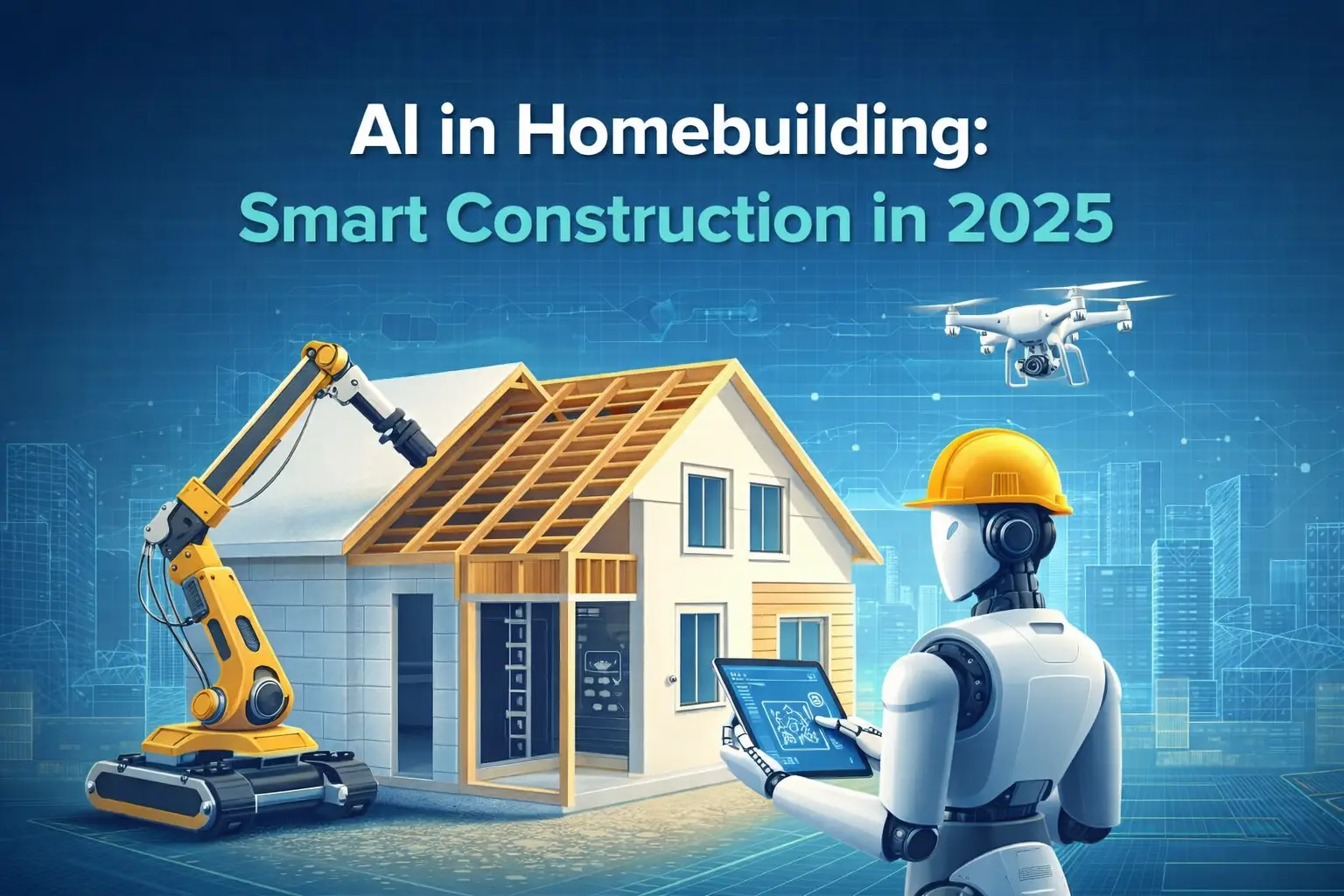
How Artificial Intelligence Is Transforming Residential Construction
AI in Homebuilding is reshaping residential construction in 2025, making design smarter, job sites more automated, and homes more energy-efficient. The residential construction industry has reached a critical tipping point in 2025. According to industry analysis from McKinsey, AI adoption is rapidly increasing across residential construction. What was once driven by manual drafting, traditional framing, and reactive decision-making is now being reshaped by Flannel AI , smart construction technologies, and data-driven automation.
Future-proofing residential construction is no longer limited to installing smart home devices. Instead, it involves embedding intelligence across the entire homebuilding lifecycle, from conceptual design and site planning to construction execution, energy management, and long-term maintenance.
With increasing labor shortages, stricter green building regulations, and rising homeowner expectations, AI in homebuilding has become a competitive necessity, not an option.
1. Intelligence by Design: AI-Driven Generative Planning
Generative Design in Residential Architecture
Traditional CAD-based workflows are rapidly being replaced by AI-powered generative design platforms. These tools allow builders, architects, and developers to optimize multiple constraints simultaneously, including:
- Construction cost optimization
- Local zoning and building code compliance
- Climate and environmental conditions
- Material efficiency and sustainability
AI-Generated Floor Plans and Lot-Fit Analysis
Modern AI platforms can generate code-compliant residential floor plans in seconds. Builders can instantly perform lot-fit analysis across entire developments, identifying setbacks, zoning conflicts, and inefficiencies that previously required weeks of manual review.
Key Benefits:
- Faster project approvals
- Reduced design errors
- Scalable planning for large housing communities
Digital Twins for Predictive Performance
Before construction begins, builders now create digital twins, virtual replicas of homes that simulate:
- Structural integrity
- Thermal and energy performance
- Flood, earthquake, and disaster resilience
This AI-powered simulation ensures homes are structurally sound, energy-efficient, and future-ready before a single shovel hits the ground.
2. Smart Construction: The Robotic Job Site
In 2025, the term “smart construction” primarily refers to the efficiency, automation, and intelligence of the construction process itself. AI in Homebuilding is accelerating the shift toward robotic job sites and data-driven construction workflows. AI-powered robotics, computer vision, and predictive analytics are actively addressing the industry’s most persistent challenge: skilled labor shortages.
AI in Homebuilding and Smart Construction Technologies
| Technology | Application | Key Benefit |
|---|---|---|
| Robotic Layouts | Printing digital construction plans directly onto the subfloor. | Eliminates manual marking errors and delivers millimetric precision. |
| Automated Masonry | Autonomous robots laying bricks or CMU (Concrete Masonry Unit) blocks. | Increases production capacity while improving on-site safety. |
| Drones & Computer Vision | Real-time site monitoring for construction progress and safety compliance. | Detects safety violations, tracks material inventory, and reduces delays. |
| Predictive Analytics | AI-driven scheduling tools that run millions of build scenarios. | Optimizes construction timelines around weather patterns and supply chain disruptions. |
3. Future-Proofing the Living Experience with AI
Smart Homes Powered by Artificial Intelligence
A truly future-proof home is designed to adapt over decades, not just meet today’s standards. AI now acts as the central intelligence behind modern residential infrastructure.
Electrification as the New Baseline
By 2025, homebuilders are rapidly shifting away from fossil fuels. AI-driven smart electrical panels manage high-load demands from:
- Electric vehicle (EV) chargers
- Heat pumps
- Home battery storage systems
These systems dynamically balance energy loads, preventing grid strain and reducing energy costs.
Predictive Maintenance Through IoT and AI
Modern homes are now built with IoT sensors embedded into HVAC, plumbing, and electrical systems. AI continuously analyzes sensor data to detect:
- Water leaks before structural damage occurs
- HVAC inefficiencies and failing components
- Electrical faults before system failure
This predictive maintenance approach significantly reduces long-term repair costs and improves homeowner satisfaction.
AI-Assisted Sustainable Material Selection
AI tools help builders select low-carbon, eco-friendly building materials that meet increasingly strict green building codes. This ensures compliance with regional sustainability mandates while reducing environmental impact.
4. The Shift Toward Industrialized and Modular Construction
AI-Powered Off-Site Construction
The future of homebuilding is increasingly off-site and factory-driven. Modular and panelized construction relies on AI to ensure zero-tolerance precision, allowing factory-built components to fit perfectly on-site.
Robotic Fabrication and Quality Control
AI-controlled robotic systems fabricate wall panels, floor assemblies, and roof structures with unmatched accuracy. This results in:
- Faster construction timelines
- Higher quality control
- Reduced material waste
- Lower overall project costs
Local builders can now deliver high-quality, affordable housing at scale, meeting rising demand without compromising standards.
Industry Insight: AI Adoption in Homebuilding (2025)
As of 2025, over 20% of mid-to-large-scale homebuilders have integrated AI into:
- Market analysis
- Project planning
- Design optimization
- Construction scheduling
This shift signals a permanent transformation. AI-driven homebuilding is no longer experimental, it is the new industry standard for competitiveness in high-demand residential markets.
Conclusion: AI Is the Foundation of Future-Ready Homes
AI in Homebuilding is no longer optional for residential builders in 2025. Artificial Intelligence is redefining every layer of residential construction, from design intelligence and robotic execution to sustainable living and long-term performance optimization.
Homebuilders who adopt AI today are not just building houses, they are creating resilient, adaptive, and future-proof homes that meet the demands of modern homeowners and tomorrow’s regulatory landscape.
In 2025 and beyond, AI in homebuilding is not about replacing human expertise, it’s about amplifying it.